
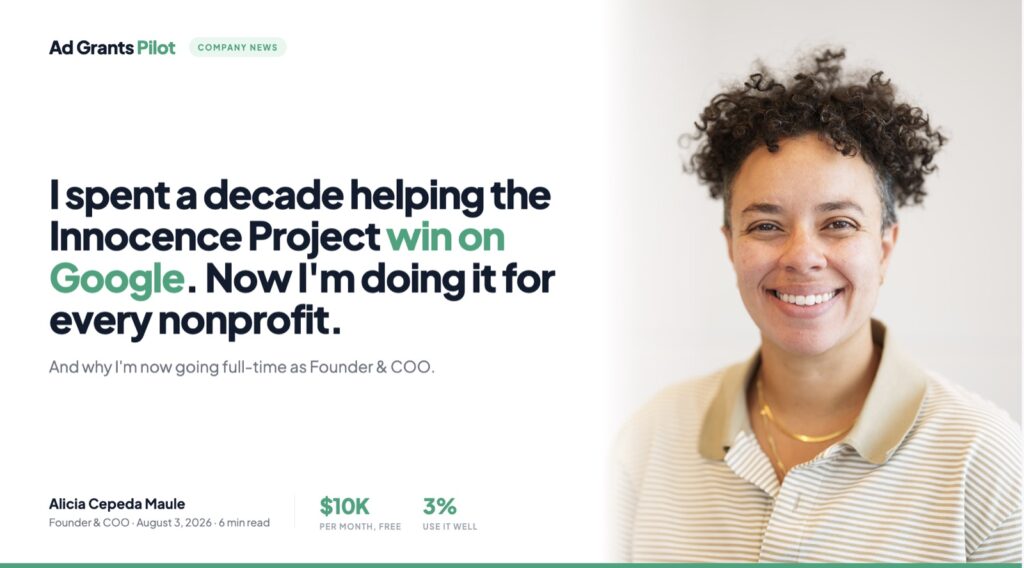
Today is my first day working full time on Ad Grants Pilot. After nearly 11 years as Digital Engagement Director at the Innocence Project, I’m closing that chapter to go all in on this one as Founder and COO. Here’s why.
The problem: an incredibly valuable resource almost no one uses well
Google Ad Grants gives eligible nonprofits up to $10,000 a month in free search advertising. Of the roughly 10 million nonprofits worldwide who could qualify, only about 3% actually take advantage of it. Not because it isn’t valuable, but because it’s too hard to use, and the alternative, hiring an agency to manage it properly, can cost up to $2,000 a month. For most nonprofits, that’s simply out of reach.
Why this is more timely than ever
- Nonprofit funding is under real pressure. Roughly $49 billion in federal grants have been terminated, and proposed federal budget cuts target hundreds of millions to billions of dollars more in specific program areas. Meanwhile, about 44% of nonprofits report reduced foundation support, according to the Center for Effective Philanthropy’s State of Nonprofits 2026 report. Free advertising dollars matter more than ever when other funding is shrinking.
- Search itself is changing. 68.01% of U.S. Google searches now end without a click to an external website, a shift driven heavily by AI Overviews and AI-powered search. Nonprofits can’t rely on SEO alone anymore. They need GEO (generative engine optimization) too. Google Ad Grants’ Performance Max campaigns are built for exactly this shift.
- Google is leaning in. The company expanded Ad Grants eligibility to more countries in 2025 and continues to double down on AI Overviews across search. The opportunity is growing, not shrinking.
Ten years in the making
The story actually starts a decade ago. I hired Steven’s agency, BlueWing, to run paid media for the Innocence Project. Ads became one of our most powerful tools, not just for growing our audience and donations, but for real impact. That work helped our policy team double the number of laws passed, and it powered campaigns to stop the execution of innocent people.
A key part of the strategy was making sure the Innocence Project was winning on Google for our cases, moments where life and death were genuinely on the line. When someone searched a client’s name, I wanted us, as the lawyers, to own the top narrative and imagery representing them, not whatever else the internet had decided to surface. When a search result can shape public opinion on a pending execution, it matters immensely who’s telling the story.
What we’ve built, and what’s next
With the advance of AI, we’ve been able to build a platform based on Steven’s decade of paid media and Google Ad Grant management experience, his best practices distilled, and bring it to nonprofits and agencies worldwide, at a price they can actually afford. Teams save time and money while getting better results than they’d get managing it themselves or paying a traditional agency.
The platform gets teams 99% of the way to launching their ads. The last mile is human: our customer success team, led by Mate Tagaj, onboards every client and monitors their progress, so nonprofits get expert support without paying agency prices.
That’s the whole thesis behind Ad Grants Pilot: the expertise that helped the Innocence Project win on Google shouldn’t be reserved for organizations that can afford a boutique agency. It should be available to every nonprofit trying to get their message in front of the people who need to see it. This is just the beginning. Our larger goal is to become the number one AI-native search platform that nonprofit and agency teams turn to, an area that’s underserved and critically important to an organization’s growth.
And the results back it up: on average, teams using their full $10K/month Google Ad Grant through our platform drive $1,700 a month in donations and 2,200 website clicks, in line with the 2026 M+R Benchmarks for a fully used grant. What started as an MVP is now validated by 40 customers, from small nonprofits with teams of two, like Children’s Surgery International, all the way up to larger organizations like Oxfam USA, plus agencies white-labeling our platform for their own clients.
Taking on this role as Founder and COO means I’m responsible for turning all of that (the story, the expertise, the early traction) into an operation nonprofits and agencies can rely on at scale.
Curious what your own Google Ad Grants account could be earning? See the full 2026 benchmarks by sector and size, or start a free trial to see it in action.
Frequently asked questions
What is Ad Grants Pilot?
Ad Grants Pilot is a platform that helps nonprofits and agencies get approved for, stay compliant with, and make the most of the Google Ad Grants program, worth up to $10,000/month in free search advertising.
Why do so few nonprofits use Google Ad Grants?
Only about 3% of the roughly 10 million eligible nonprofits worldwide take full advantage of Google Ad Grants, largely because the program is difficult to set up and maintain, and hiring an agency to manage it can cost up to $2,000 a month.
Who founded Ad Grants Pilot?
Ad Grants Pilot was co-founded by Steven Aguiar, who spent a decade managing Google Ad Grants and paid search programs for nonprofits through his agency, BlueWing, and Alicia Cepeda Maule, who began working full time as Founder and COO in August 2026, after 11 years as Digital Engagement Director at the Innocence Project.
How much can a nonprofit earn from Google Ad Grants?
Teams using their full $10,000/month grant through Ad Grants Pilot drive an average of $1,700/month in donations and 2,200 website clicks.
About the author
Alicia Cepeda Maule is Founder and COO of Ad Grants Pilot. She spent nearly 11 years as Digital Engagement Director at the Innocence Project, where she used paid media and Google Ad Grants to grow audience, donations, and policy impact, including campaigns that helped stop the execution of innocent people.
