
Quick answer: Google Ad Grants and paid Google Ads run in two different auctions, so they never compete for the same click. Ad Grants covers free, top-of-funnel search reach, worth roughly $1,700 a month in direct donations for the median nonprofit, per the 2026 M+R Benchmarks. Paid search is the uncapped channel for scaling direct fundraising revenue, averaging $2.48 back for every $1 spent. Most nonprofits serious about fundraising end up running both, for different jobs.
We hear a version of this question from almost every new nonprofit we work with, and it comes from one of two directions.
Either: “We just got approved for Google Ad Grants, do we still need to spend money on Google Ads?”
Or, less often: “We already run paid Google Ads, is it even worth applying for the grant?”
Both questions assume the two programs are substitutes. They aren’t. They run on the same platform, but they don’t compete in the same auction, and they’re built to do different jobs. Getting that wrong is how nonprofits either leave free reach on the table or expect a grant account to do something it structurally can’t.
For a full walkthrough of the grant program itself, see our Complete Guide to Google Ad Grants. This post is about how it compares to paid.
They aren’t the same auction
Start here, because everything else follows from it.
Grant ads and paid ads never bid against each other. Google runs the paid auction first. Paying advertisers fill the available slots. Ad Grants ads then compete in a second, separate auction for whatever space is left over, appearing below the paid results or on searches where no paid advertiser showed up at all.
Google states this in its own Ad Grants program FAQ: grant and paid accounts don’t compete with one another, because Ad Grants ads run in a separate auction after paid ads.
What that means in practice: if commercial advertisers have taken every slot on a search like “donate to cancer research,” there’s no leftover inventory, and your grant ad doesn’t appear. Your bid didn’t lose. Your ad was never in that auction to begin with.
The effect is uneven across query types. On informational, educational, service-related, local, and branded searches, paid competition is thin and grant ads run consistently. On high-intent donation terms, where commercial fundraisers and every other grantee are crowding the same page, grant coverage falls off hard.
That single mechanic explains most of the ceiling on what an Ad Grants account can produce, no matter how well it’s built.
What Google Ad Grants actually is
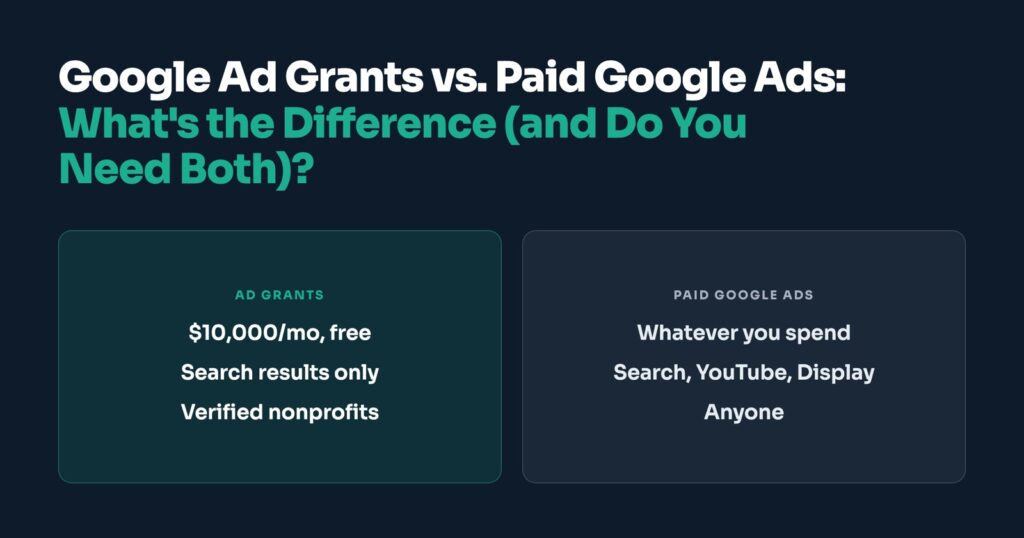
Google Ad Grants gives eligible 501(c)(3) nonprofits up to $10,000 a month in in-kind advertising credit, roughly $329 a day, in 185+ countries.
The credit comes with structural limits, not just a spending cap. Grant accounts run text ads on Google Search, plus Performance Max, which was opened to the program in 2025 and serves on Search, AI Overviews and eligible Google Maps placements only. What you can’t do is run standalone Display, YouTube, Shopping, or Discovery campaigns, and you can’t remarket to people who’ve already visited your site.
There are program rules to maintain, too: every keyword has to contain at least two words, every ad has to point to an approved domain, advertiser verification has to be complete, and conversion tracking has to be live and reporting. Full detail is in our Ad Grants policy requirements article, alongside the website quality requirements we’ve covered elsewhere.
What paid Google Ads is
Standard paid Google Ads is the same platform, minus the grant program’s restrictions, available to anyone willing to pay for clicks.
There’s no monthly ceiling beyond what you budget. No keyword restrictions. No approved-domain limitation. Paid campaigns run across all of Google’s inventory: Search, Display, YouTube, Shopping, Discovery. They support remarketing to warm audiences. And critically, they enter the primary auction, which means a nonprofit with paid budget can win the donation-intent searches a grant account can only pick up scraps on.
What each program is realistically for
This is where most of the confusion lives, so it’s worth being blunt about it.
Ad Grants can drive donations, but there’s a ceiling. The average nonprofit sees somewhere around $1,700 a month in direct donations attributable to the grant, per the 2026 M+R Benchmarks. That average hides enormous variance. Large organizations with strong brand recognition pull well above it. Small organizations with little brand search pull well below it, and performance swings hard by vertical.
Where Ad Grants earns its keep is top of funnel. Roughly 2,290 free clicks a month from people searching your cause, your programs, or your services. Those visitors become email subscribers, event registrants, volunteers, and retargeting audiences for every other channel you run. Valued at market rates, that’s $120,000 a year of media exposure a nonprofit didn’t have to raise. Judging it purely on direct donation ROAS misses most of what it’s doing.
Paid search is the financial cornerstone of any direct fundraising program you intend to scale. Nonprofit paid search returns roughly $2.48 in donation revenue for every $1 spent, per the 2026 M+R Benchmarks. Unlike the grant, that isn’t capped at $10,000 a month. The only real constraint is how much qualified search volume exists for your cause and how efficiently you can buy it. If you want to build a fundraising channel that grows year over year, that’s the channel that does it.
The comparison, side by side
| Google Ad Grants | Paid Google Ads | |
|---|---|---|
| Cost | Free (in-kind credit) | You pay per click |
| Monthly ceiling | $10,000 (fixed) | Whatever you budget |
| Auction | Secondary auction, runs after paid advertisers fill the available slots | Primary auction |
| Ad networks | Search text ads, plus Performance Max limited to Search, AI Overviews and Maps placements | Search, Display, YouTube, Shopping, Discovery |
| Remarketing | Not available | Available |
| Keyword rules | No single-word keywords, any match type | No restrictions |
| Landing pages | Approved domains only | Any domain |
| Eligibility | Registered 501(c)(3) nonprofits meeting Google for Nonprofits criteria | Anyone |
| Typical role | Awareness, education, list building, brand capture, a modest donation stream | Scalable direct fundraising, competitive donation terms, remarketing |
When Ad Grants on its own is enough
For a lot of small and mid-sized nonprofits, it is.
If your goals are visibility for your mission, educating people who are already searching for your issue, filling your email list, driving volunteer and program sign-ups, and capturing branded search so someone else doesn’t, the grant covers that well and costs nothing.
It’s also the right and only starting point if you don’t yet have donation-value conversion tracking in place. Running paid budget into an account that can’t measure gift value is how nonprofits spend a year flying blind.
When you need paid too
Some of this is obvious: anything the grant structurally can’t run. Display or YouTube for broader campaign awareness. Remarketing to people who visited your donation page and didn’t give. Shopping for a merchandise program.
The bigger reason is less obvious. If you want a direct fundraising program that scales, you need paid search, and you do not need to max out your grant account first.
That’s a correction to a piece of conventional advice we’ve given ourselves in the past. “Maximize the free channel before you pay for anything” sounds prudent, but it conflates two different objectives. Maxing out the grant means you’ve captured all the leftover inventory available to you. It says nothing about the donation-intent searches sitting in the primary auction that your grant account was never eligible to win.
A nonprofit with $3,000 a month to invest and a working donation page can start building that program now, in parallel, while the grant account keeps doing the awareness work. Waiting until the grant hits $10,000 a month just delays the channel that actually compounds.
The practical sequence we’d recommend: get donation-value tracking verified, start paid on brand and your highest-intent donation terms at modest spend, find the return, then scale. Run the grant alongside it for everything else.
This is a separate question from who manages the accounts day to day. If that’s what you’re weighing, we cover it in our agency vs. DIY vs. Ad Grants Pilot comparison.
Frequently asked questions
We have Ad Grants. Do we still need to pay for ads?
Only if your goal is a fundraising program that scales past a few thousand dollars a month. If your goal is search visibility for your mission, the grant covers that on its own. The grant can’t reach the donation searches paid advertisers have already claimed, and no amount of good account management changes that.
Should we stop using Ad Grants once we have paid budget?
No reason to. It’s free inventory in a separate auction, so it isn’t cannibalizing anything. The two are additive.
Will running paid ads put our Ad Grants eligibility at risk?
No. Compliance is evaluated on the grant account itself. We’d still recommend keeping the two structurally distinct, with separate campaigns and clear internal ownership, so reporting stays clean on both sides. In our own client reporting we never blend grant and paid performance into a single number. Doing so hides which one is actually working.
Does Ad Grants spending count against a paid Google Ads budget?
No. They’re separate accounts with separate budgets. Grant spend never touches, and never limits, whatever you commit to a paid campaign.
What does it cost to manage a Google Ad Grants account?
The grant itself is free, up to $10,000 a month in in-kind credit. Most nonprofits still need help running it well. Agencies typically charge $500–$2,000 a month for that; Ad Grants Pilot does it for $199 a month.
A simple way to decide
If you want to be visible to people searching your cause and you’re not yet running a measurable donation program, start with the grant. Check your Ad Grants Readiness Score to see how much of that opportunity your site is positioned to capture.
If you want donation revenue that grows past a few thousand dollars a month, that’s a paid budget conversation, and it’s one you can start now rather than after the grant is maxed.
Most organizations serious about digital fundraising end up running both, doing different jobs, measured separately.
Get your free Ad Grants Readiness Score → https://adgrantspilot.com/ad-grant-readiness/
Related reading: Search Demand and Google Ad Grants · Competition in Google Ad Grants · Agency vs. DIY vs. Ad Grants Pilot · Children’s Surgery International case study
Auction mechanics are sourced from Google’s own Ad Grants program FAQ, which states that grant and paid accounts do not compete because Ad Grants ads run in a separate auction after paid ads. Donation, click, and ROAS figures are sourced to the 2026 M+R Benchmarks Study (Google Grants and Digital Advertising sections). Performance Max placement scope and compliance thresholds are sourced from our Ad Grants Policy Requirements knowledge base article. Cross-check against Google’s official Ad Grants policy page before relying on program rules, since they’re updated periodically.